- Who this is for: CIOs, CTOs, Enterprise Architects, Engineering Leaders
- Problem it solves: Architectural decisions copied from trends without considering business environment
- Key outcomes: Reduced complexity, improved system resilience, controlled cloud costs, stronger delivery predictability
- Time to implement: 60--90 days for environmental assessment and alignment
- Business impact: Lower operational instability and architecture aligned to growth stage
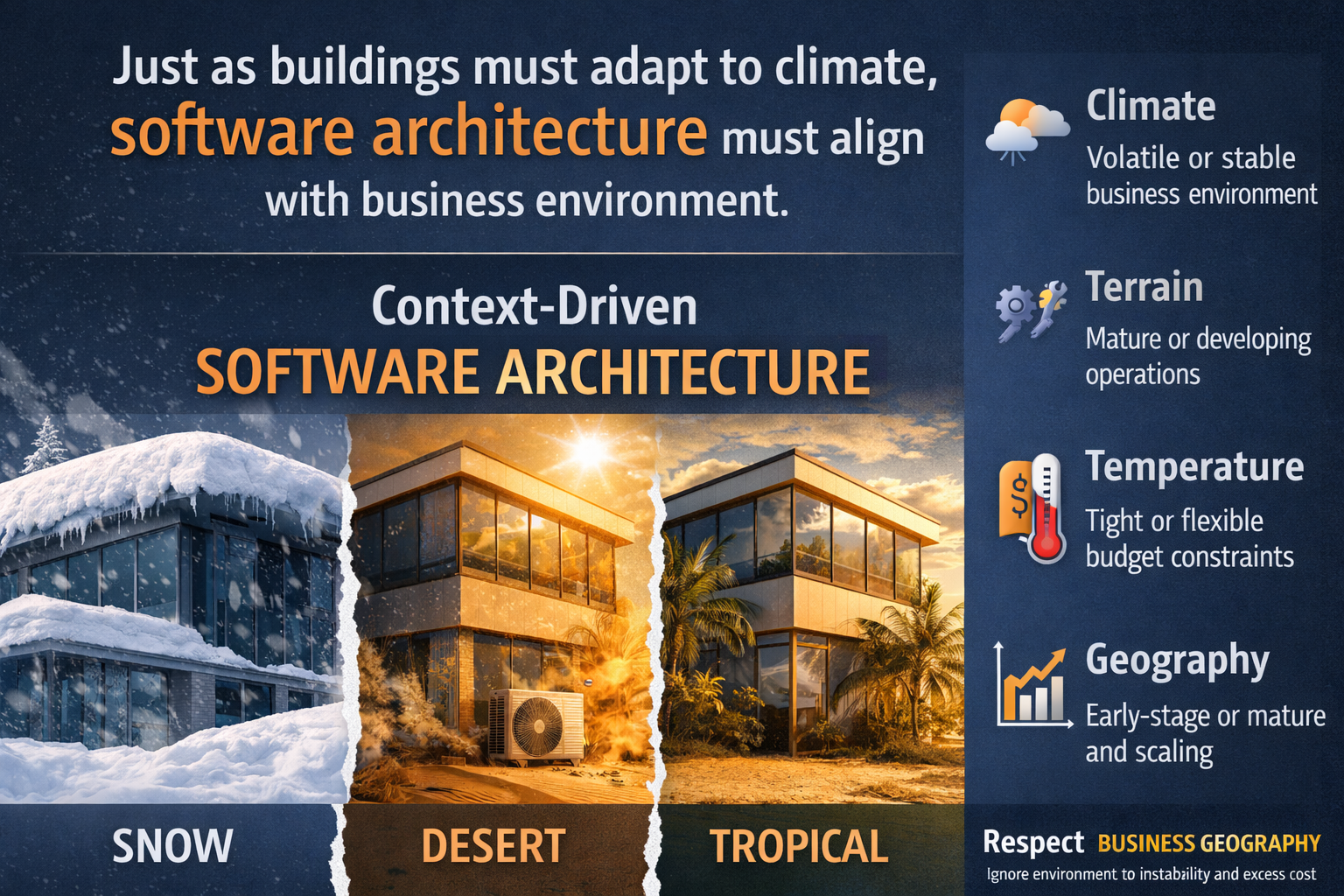
Snow, Sand, and Structural Failure
Imagine you are designing a building in a region where snow reaches three meters each winter.
If the roof is flat, it collapses.
Weight accumulates. Stress increases. The structure fails --- not because the materials were poor, but because the design ignored geography.
Now move that same blueprint to a desert climate.
Thick insulation traps heat. Large glass surfaces amplify temperature. Energy costs surge. Cooling systems overload.
Again --- not a material failure.
A context failure.
Now imagine building in a tropical coastal region.
Humidity corrodes. Ventilation becomes critical. Materials expand and contract.
The same blueprint cannot survive all three environments.
Physical architecture respects geography.
Yet in software, we often deploy identical architectural blueprints across radically different business climates --- and expect stability.
The Quiet Collapse in Software Systems
A mid-sized enterprise adopts a microservices architecture inspired by high-scale technology firms.
On paper, it looks modern. Distributed. Event-driven. Cloud-native.
Six months later:
- Deployment coordination doubles
- Incident frequency rises
- Observability gaps increase
- Cloud costs climb faster than revenue
Nothing is technically "wrong."
The architecture simply does not match the environment.
Industry research consistently shows that architectural complexity is one of the leading drivers of operational instability. Cloud waste analyses estimate 20--30% overspend due to structural inefficiencies.
Most failures are not technical.
They are contextual.
Software has geography.
We simply fail to name it.
Why Trend-Driven Architecture Fails
Organisations frequently choose architecture based on:
- Industry narratives
- Hiring trends
- Conference influence
- Competitive mimicry
Microservices become default. Event streaming becomes assumed. Service meshes become mandatory.
But architecture is not fashion.
It is structural engineering.
Without evaluating:
- Business volatility
- Organizational maturity
- Cost tolerance
- Growth stage
Complexity becomes structural snow load.
Governance weakens. Decision latency increases. Execution predictability declines.
Architecture must respond to environment --- not trend cycles.
The Business Geography Framework
To evaluate architectural fitness, I use a structured four-dimension environmental model.
Software does not run in abstraction.
It operates within business geography.
1. Business Climate (Volatility)
- Is your revenue pattern stable or fluctuating?
- Are seasonal spikes extreme?
- Is regulatory change frequent?
- Is experimentation central to strategy
High volatility demands elasticity and decoupling.
Stable climates reward simplicity and cost control.
Architectural elasticity must match business climate.
2. Organizational Terrain (Operational Maturity)
What is the maturity of your engineering organization?
- DevOps capability
- Observability discipline
- Incident response coordination
- Platform engineering presence
- Decision governance clarity
A distributed system without operational discipline behaves like a heavy snow roof without reinforcement.
Capability must support complexity.
3. Economic Temperature (Cost Sensitivity)
Architecture carries financial implications.
- Startup runway constraints
- Enterprise cost-optimization mandates
- Public company margin expectations
Highly distributed systems increase:
- Monitoring overhead
- Infrastructure variability
- Coordination cost
Not every business can afford high structural insulation.
Architecture must align with economic temperature.
4. Growth Geography (Lifecycle Stage)
Are you:
- Searching for product-market fit?
- Scaling aggressively?
- Optimizing margins?
- Expanding globally?
Early-stage organisations prioritize speed. Mature enterprises prioritize reliability and governance stability.
Architecture must evolve as geography changes.
Implementation Guide (90-Day Alignment)
Phase 1: Environmental Mapping (Weeks 1--3)
Objective: Diagnose architectural misfit
Activities: - Map architecture style against business volatility
- Assess operational maturity
- Evaluate cost distribution
- Review incident and deployment data
Success Metric: - Clear environmental misalignment report
Phase 2: Fitness Evaluation (Weeks 4--6)
Objective: Determine structural overreach or underinvestment
Activities: - Identify over-distributed components
- Assess service dependency density
- Evaluate cost-to-value ratios
- Review governance checkpoints
Success Metric: - Prioritized adjustment roadmap
Phase 3: Controlled Realignment (Weeks 7--12)
Objective: Improve structural fit without destabilization
Activities: - Simplify where complexity exceeds need
- Introduce resilience where volatility demands
- Align architecture decision records
- Strengthen governance rhythms
Success Metric: - Reduced incident variability
- Improved deployment predictability
- Stabilized cloud cost growth
Resource Estimate:
1 Principal Architect, 1 Engineering Lead, Platform representation
Evidence from Practice
The Challenge
In a previous engagement, a growing enterprise adopted a fully distributed microservices ecosystem inspired by high-scale technology firms.
Transaction volumes were stable.
Regulatory volatility was low.
DevOps maturity was still developing.
Within months:
- Incident coordination increased significantly
- Deployment dependency management doubled
- Cloud cost growth accelerated
The system was architecturally advanced.
But environmentally misaligned.
The Approach
We conducted a structured business geography assessment across volatility, maturity, cost sensitivity, and growth stage.
Selective consolidation reduced service sprawl.
Governance checkpoints were formalized.
Architecture decisions were re-evaluated against environmental need.
The Results
Within four months:
- Deployment coordination reduced by approximately 30%
- Incident frequency declined
- Cloud cost growth stabilized
- Engineering productivity improved
No new technology was introduced.
Fit was restored.
Action Plan
This Week
- Identify your current architectural model
- Assess whether it matches your business volatility
Next 30 Days
- Conduct structured environmental mapping
- Evaluate operational maturity vs system complexity
- Review cost-to-value distribution
3--6 Months
- Integrate environmental assessment into architecture governance
- Align ADR reviews with business geography
- Establish quarterly structural fitness reviews
Final Thought
A flat roof collapses under snow.
Glass overheats in desert sun.
Materials corrode in tropical humidity.
Failure is rarely about strength.
It is about misfit.
Software architecture is structural engineering for business.
Respect geography.
Next Step
If your architecture feels heavier than your business requires --- or lighter than your growth demands ---
→ Book a 30-minute strategy consultation
Environmental clarity drives execution stability.